Free shipping for all orders over $65 (before taxes)*



Blog
Transforming Your Bathroom with Non-Toxic Alternatives


What if your bathroom finally became a truly healthy space?
Long perceived as a purely functional area, the bathroom is now at the center of a broader awareness: our daily exposure to invisible, yet very real, substances.
Between personal care products, water, textiles, and even indoor air, this space concentrates a wide range of factors that directly influence skin health, hormonal balance, and overall well-being.
This shift toward more natural choices is supported by science. According to the World Health Organization, endocrine-disrupting chemicals are a global concern due to their ability to interfere with the hormonal system and impact human development and health.
Similarly, the National Institute of Environmental Health Sciences explains that these substances can mimic or block hormones and are associated with various health effects, including those related to reproduction, metabolism, and development.
In this context, rethinking the bathroom is no longer just an aesthetic choice; it becomes a holistic approach to health.
Water: A fundamental yet often overlooked element
Water comes into direct contact with the skin every day. Yet, it can contain chlorine and various byproducts from municipal treatment processes.
While these treatments are essential for public health, research suggests that repeated exposure to certain environmental chemicals, including those found in water, contributes to the overall chemical burden placed on the body.
In a warm, enclosed environment like a shower, inhaling steam may also represent an additional pathway of exposure.
Installing a shower filter therefore becomes a simple yet meaningful step in reducing cumulative exposure.

Rethinking personal care: less, but better
Conventional personal care products may contain substances such as phthalates, often used in fragrances.
According to Consumer Reports, these compounds are recognized as endocrine disruptors and have been linked to potential effects on fertility, cardiovascular health, and development.
Because these substances are found in many everyday products, including cosmetics and scented items, overall exposure can quickly accumulate.
This is why more consumers are turning toward simpler formulations, free from synthetic fragrances and controversial ingredients.
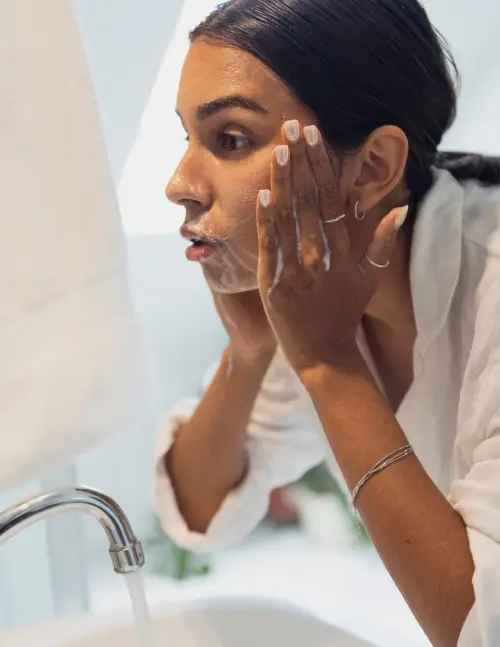
A return to essential, ancestral ingredients
In response to increasingly complex formulations, there is a growing return to simple, traditional ingredients.
While scientific research tends to focus more on identifying harmful substances than validating traditional alternatives, the current movement is grounded in a key principle; reducing cumulative exposure to complex chemical mixtures.
This aligns with findings highlighted by the World Health Organization, which emphasize that daily exposure is not tied to a single product, but rather to the accumulation of multiple sources.
Choosing raw, minimally processed ingredients is one way to simplify and reduce that exposure.
At the same time, plastics remain ubiquitous in the bathroom; containers, razors, brushes.
According to the National Institute of Environmental Health Sciences, compounds such as bisphenol A (BPA) and phthalates, commonly found in plastics, can migrate into the environment and come into contact with the body.
Replacing these materials with more stable alternatives like glass or stainless steel can help reduce this often-overlooked source of exposure.
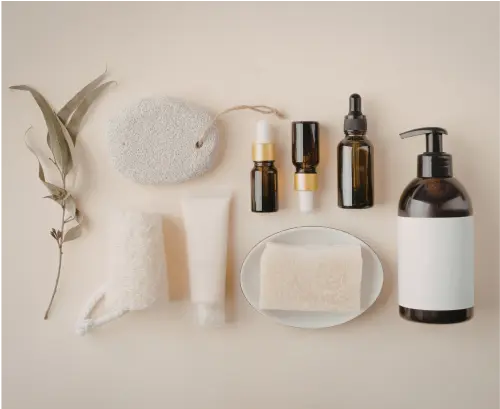
Indoor air: an underestimated factor
Scented candles and fragranced products can release chemical compounds into the air.
Fragrances, often protected as trade secrets, may contain phthalates or other undisclosed substances.
These compounds can contribute to indoor air pollution and repeated exposure, particularly in enclosed spaces like bathrooms.
Opting for fragrance-free products or improving ventilation can significantly enhance indoor air quality.

Textiles: direct contact with the skin
Bathroom textiles such as towels, bath mats, and shower curtains are in direct contact with the skin, often in humid conditions.
Synthetic fibers may contain chemical residues from manufacturing and contribute to overall exposure to certain substances.
More broadly, research indicates that many everyday items, including textiles, plastics, and cosmetics, can contain endocrine-disrupting chemicals.
Choosing natural fibers such as cotton offers a more breathable and skin-friendly alternative.

Rethinking care: a more conscious approach
Rethinking your bathroom ultimately means redefining your relationship with self-care.
It means recognizing that every choice; products, materials, habits, contributes to an overall environment that directly affects the body.
At Actumus, this philosophy aligns with a vision of well-being rooted in simplicity, transparency, and quality.
Because creating a healthier environment does not begin with changing everything; it simply begins with the decision to start.
Bibliography
- World Health Organization. (2012). State of the Science of Endocrine Disrupting Chemicals 2012. United Nations Environment Programme and World Health Organization.
- World Health Organization. (2023). Endocrine Disrupting Chemicals and Child Health. Retrieved from https://www.who.int
- National Institute of Environmental Health Sciences. (2024). Endocrine Disruptors. U.S. Department of Health and Human Services. Retrieved from https://www.niehs.nih.gov
- Endocrine Society. (2015). Endocrine-Disrupting Chemicals: An Endocrine Society Scientific Statement (2nd ed.). Endocrine Reviews, 36(6), E1–E150.
- United States Environmental Protection Agency. (2023). Volatile Organic Compounds’ Impact on Indoor Air Quality. Retrieved from https://www.epa.gov
- Consumer Reports. (2022). Concerning Ingredients in Cosmetics and Beauty Products. Retrieved from https://www.consumerreports.org
- National Institute of Environmental Health Sciences. (2023). Bisphenol A (BPA). U.S. Department of Health and Human Services.